 omldeen
Coaxial lightning protector plays a vital role in the communication system. It can not only prevent lightning induced voltage into the signaling system, but also in a short period of time to release the high current, thus effectively protecting the antenna, transceiver equipment and video surveillance systems. However, the quality of the product is not enough, the correct installation also determines the lightning protection effect. As an experienced manufacturer of coaxial lightning protectors, this article will introduce you to the scientific installation methods and common considerations.
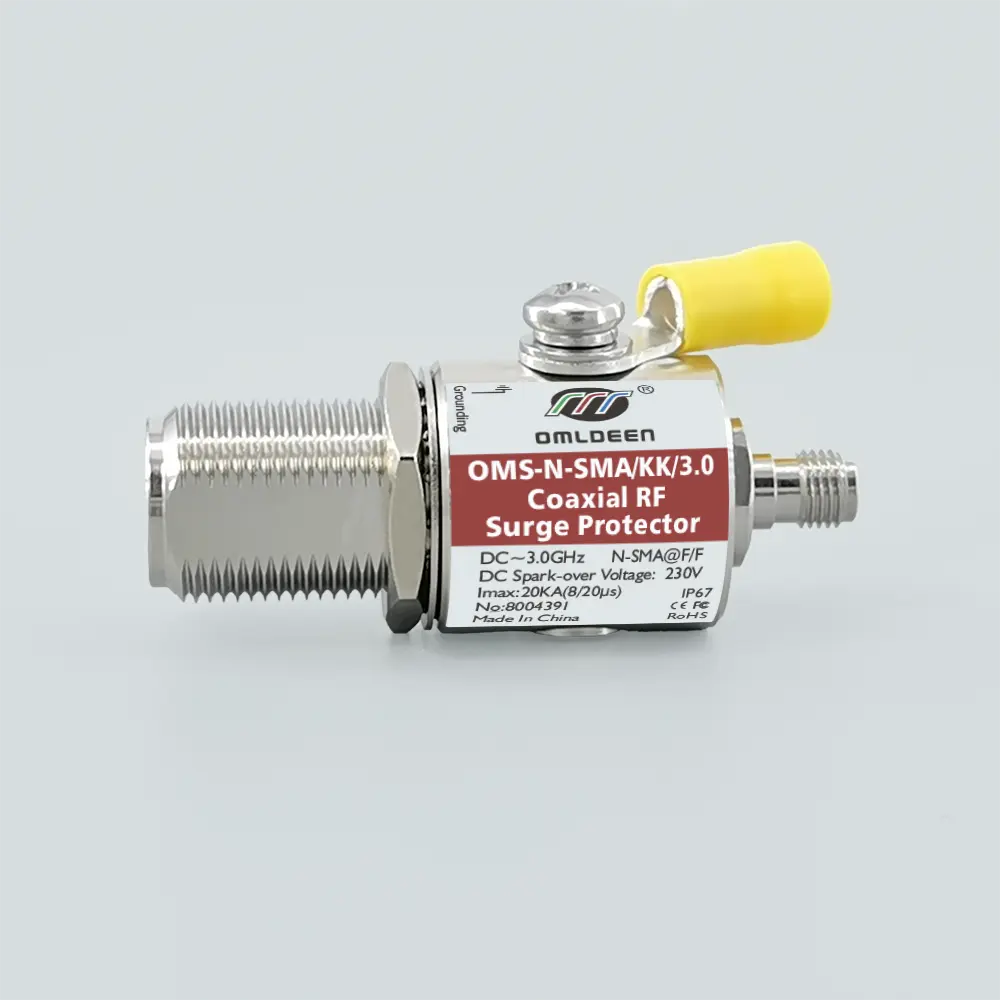
Preparation before installation
Clarify the system parameter requirements
Before installation, you should select the lightning protector that matches the equipment according to the system’s operating frequency, impedance, interface type and other parameters. For example: N-type interface is suitable for most communication base stations, BNC type is suitable for video signals, SMA is mostly used for microwave or low-power equipment. It is recommended to give preference to the products of the lightning protector manufacturer with complete description of technical parameters.
Check the product status
Check whether the appearance of the lightning protector is intact, without scratches, cracks, rust, etc., and the interface should be smooth and free of impurities; and make sure that the product markings are clear, including the frequency range, the maximum throughput, and the installation direction.
Prepare the grounding system
One of the key roles of the coaxial lightning arrester is to introduce the lightning current into the ground, so it must be connected to a reliable grounding system, and the grounding resistance should be less than 10 ohms. Lightning rod manufacturers or electrical engineers can provide standardized grounding design and construction services.
Reasonable choice of installation location
The installation location should be chosen at the first point before the signal line enters the equipment, which is usually one of the following two locations:
Antenna interface: near the antenna end, for the first line of protection
Equipment input port: near the receiver, switch, or video host, for the second line of protection
It is recommended to install a lightning protector at both ends, to build a hierarchical protection mechanism, and to improve the overall safety level
Standard Installation Procedure
Power-off Operation: The power of the equipment must be turned off before installation or replacement to ensure safe operation.
Fixed connector: Use a wrench to firmly connect the coaxial lightning protector to the signal line interface, be careful not to over-tighten to avoid damage to the threads.
Grounding lead: connect the grounding end of the lightning protector to the ground through copper braided wire or multi-stranded copper wire, the shorter the length of the wire, the better, preferably no more than 50cm, the path should be straight and tangle-free.
Do waterproof treatment: For outdoor applications, the interface must be protected against rainwater erosion using waterproof tape or sealing sleeve.
Labeling records: Record the installation time and product batch for later maintenance and replacement.
Common Errors and Risk Prevention
Even if you use a high-quality lightning protector, if it is not installed properly, it will greatly reduce the protective effect. The following are common mistakes:
- not grounded or grounding resistance is too large: resulting in lightning current has no place to release, the lightning protector is virtually non-existent;
- grounding lead is too long or winding: it will cause induced rebound voltage, affecting the protection effect;
- direction reversed: the coaxial lightning protector has a directional (IN / OUT), reversed will affect the signal transmission;
- long-term non-inspection and maintenance: overloading failure is not replaced in a timely manner, equal to the “False protection”.
Therefore, it is recommended that customers regularly ask the lightning protector manufacturer or qualified engineering service providers for inspection and maintenance.